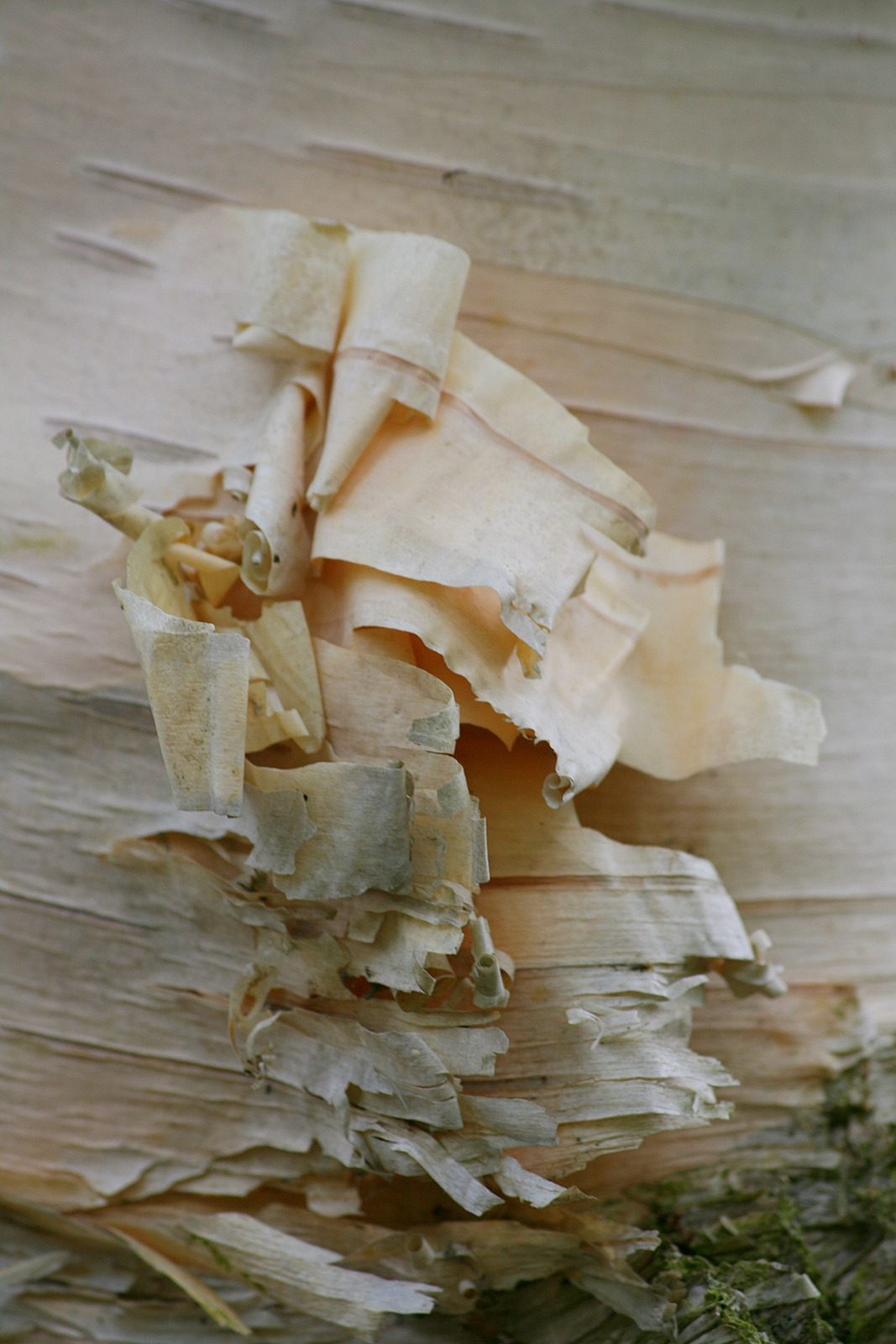
Bark Structure and What Can Be Harvested
The bark of silver birch (Betula pendula) and downy birch (Betula pubescens) consists of two distinct layers. The outer bark (rhytidome), which gives birch its characteristic white appearance, is composed of suberised cells rich in betulin — a triterpenoid that makes bark water-resistant and resistant to decay. This outer layer can be peeled from mature trees.
Beneath it lies the inner bark (phloem), which is the living tissue responsible for conducting sugars from leaves to roots. Removing the inner bark — or damaging it by cutting too deeply — girdles the tree and kills it. Sustainable harvest therefore means taking only the outer periderm layers, leaving the green or cream-coloured phloem intact.
Key distinction: Outer birch bark (white, papery) can be removed sustainably. Inner bark (greenish-white, moist) must never be stripped — doing so severs the tree's nutrient transport and is fatal.
Historical Context in Polish Forest Culture
Archaeological and ethnographic records from the territory of present-day Poland document birch bark use dating back to at least the early medieval period. Bark sheets were used as writing material (small notes and administrative records on birch bark have been found at settlement sites in the Baltic region), as waterproofing for roof shingles, and as raw material for baskets, containers, and shoe components.
In the Kurpie region of northeastern Mazovia, birch bark weaving was historically part of local craft production. The Kurpie people developed specific basket forms using both whole bark sheets and narrow strips cut from the outer layer. Some of this knowledge has been preserved through craft revival projects, though it is no longer practised commercially at scale.
Birch tar — produced by dry distillation of bark — was a standard adhesive and preservative in the pre-industrial period across Northern and Central Europe. Polish forest communities used it for waterproofing leather, sealing wooden vessels, and preserving tool handles.
Sustainable Harvest Guidelines
The following guidelines are drawn from general forestry and ethnobotanical literature. They do not substitute for local regulatory requirements (see the legal note below).
- Season: Early to midsummer is the recommended window. During active growth, the outer bark separates more cleanly from the phloem. Attempting to harvest in winter or early spring, when the tree is dormant, risks tearing into the living layer.
- Coverage limit: Remove bark from no more than one-quarter of the circumference of a trunk at any given height. Wider removal can impair structural integrity and increases the risk of fungal infection at the wound site.
- Height distribution: Spread the harvest vertically along the trunk rather than concentrating it at one band. This reduces the visual impact and distributes wound stress.
- Tree size: Only harvest from trees with a trunk diameter above 15–20 cm. Smaller trees have thinner bark layers and a proportionally larger phloem, making accidental damage more likely.
- Wound care: No sealant is typically needed for correctly executed outer bark removal. The exposed surface dries and darkens but does not require treatment.
Contemporary Small-Scale Applications in Poland
At present, birch bark in Poland is used in small-scale craft and artisanal contexts rather than industrial production. Observable uses include:
- Basketry and containers: Workshops in the Białystok and Olsztyn regions have documented production of birch bark boxes and trays, often using traditional Kurpie-style weave patterns.
- Decorative items: Sheets of bark are used in folk art for painting on a natural surface — a practice with documented roots in Podlaskie ethnographic traditions.
- Tinder and fire-starting: Dry outer birch bark ignites readily due to its betulin content and is used in bushcraft and traditional forest skills contexts.
- Birch tar production: Small-scale experimental production for historical reenactment and natural product contexts. This involves kiln distillation and is distinct from simple bark peeling.
Legal Considerations
Stripping bark from trees in Polish State Forests without authorisation can constitute damage to forest property under Polish law, regardless of whether the tree survives. The Act on Forests and related regulations do not create a general right to harvest bark the way some mushroom and berry collection is permitted.
Anyone intending to collect birch bark in State Forest areas should contact the relevant Forest District (Nadleśnictwo) in advance. Private landowners control access to their own woodland independently. Activity in nature reserves or Natura 2000 sites requires additional assessment under nature protection legislation.
Useful starting point: Lasy Państwowe contact directory.